Tuesday, June 2, 2009

Tetris game::: TVC's case study"Happy 25th birthday!"

Tetris is 25 years old today!

Google have changed their home page logo in honour of the Tetris birthday:


Tetris Google logoand other sites are running retrospectives - check out the Telegraph's Tetris gallery here.

There is no doubting the impact that Tetris had on driving the gaming market. Created by Russian computer engineer Alexey Pajitnov, Tetris has sold more than 70 million copies and been systematically re-worked and re-released for almost every video-game platform of the past 20 years.

Over time the influence of Tetris has also reached into popular culture in a number of areas - the Telegraph gallery showcases Tetris fashion and Tetris furniture too:

Tetris tshirtTetris fashion

Tetris kitchenTetris Kitchen

and Tetris was so popular that it even resulted in Doctor Spin having a UK hit record with a dance version of the Tetris theme music, seen here on Top Of The Pops in October 1992 (!):


Happy birthday Tetris!

It's been 25 years since Alexey Pajitnov, then a 29-year-old artificial intelligence researcher, came up with Tetris while working at the Soviet Academy of Sciences in Moscow. "A quarter of a century later," the Guardianreports, "it has a legitimate claim to being the videogame that has truly conquered the world. In all its forms, Tetris has sold more than 70 million copies around the globe; it has spawned architecture, art and music; it has earned multiple Guinness World Records; and is regularly voted one of the top games of all time." It's also enjoyed its share of goofy ads. .




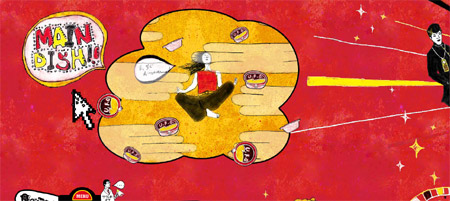
Nissin Ufo Noodles website

Nissin Ufo Noodles

nissin_ufo04.jpg

It's also interesting to see such an unusual artistic approach to food marketing. No fancy perfect pictures of the food, but rather a colorful chaotic browsing through illustrations and animations.

nissin_ufo01.jpg

Maybe because the only way to make instant yakisoba noodles appealing is to avoid showing the product and rather focus on the aesthetics of the digital experience :-)

nissin_ufo02.jpg
nissin_ufo03.jpg

via

[Agencies] Small Vs. Big

1. Nimble. Because we don’t have a lot of people to get in the way of progress, we can turn on a dime for a client. They like that.

2. Loyal. Genuinely and to a fault. We need our precious clients to be successful, or else we’ll we’ll cease to exist. So we tend to act like we’re their partner. And really, we are.

3. Honest. Maybe too much at times. The rest of my team jokes about how “blunt” I can be with a client. Hey, if their hours suck, their staff is surly, the inventory dated, or the prices too high, someone needs to tell them…might as well be a “partner”. I care. (See Number 2.)

4. Efficient. Time is money. We’re small and don’t have the luxury of waxing poetic about a piece of creative for months. We study the issues and then work hard to sell something. Isn’t that what advertising is supposed to do, after all?

5. Hungry. We don’t eat till someone sells something. And we all know it, so we take nothing for granted.

6. Cost-conscious. Small agencies “feel the pain” of our small clients. We have to make money, but we don’t nickle and dime a client for every breath we take on their behalf.

7. Ego-less. Well, somewhat. If you think you’re the smartest one in the group, then you can’t work in a small shop. Arrogance just doesn’t work. Collaboration does.

Doritos Loves Love 2009

Augmented Reality and social networking have been fused together in a lovefest for Doritos Brazil. Packs of Doritos Sweet Chilli - the latest flavour - bear a QR code directing users online to ‘release’ aDoritos Lover, a sweet and unique little cartoon like monster. The campaign, created by Cubocc, Sao Paulo has seen some fantastic results so far with 23,000 lovers already being freed in a week.http://www.doritos.com.br/sweetchili/

Upon being released, the Lovers are added to their owner’s Orkutprofile - the largest social network in Brasil - as a special app. Owners can take pictures of their Lover, create birth certificates or even put the unwanted Lovers up for adoption!

The most exiting part though is that the Lovers have a mind of their own... with built in AI, Lovers will interact with others online and can randomly ‘introduce’ their owners to other Doritos Lovers owners... amazingly, there are over 18 trillion possible Doritos Lovers combinations!

This follows news this week that the hugely successful and equally love driven ‘
Bring slow dancing back’ Doritos campaign created by BBDO Argentina has been awarded a Platinum Sol, the highest acclaim of the Iberoamerican Festival of Advertising Communication. BBDO’s win marks the first time in the history of the festival that an Argentinean agency has been awarded the acclaim. Look out for the campaign at this year’s Cannes festival too.


Wataniya Telecom:::Open your mind


Anubis270Anubis269

Published in Epica Book Twenty One, Europe’s Best Advertising. ISBN 13: 978 2-88479-106-9.


royal_raffle04

wataniya

Client: Wataniya Telecom.

Agency: Impact & Echo BBDO

Country: Kuwait – 2009

New Media:::Movistar

Monday, June 1, 2009

GM ReBirth

GM is filing for bankruptcy and guess what? They owe a ton of money to the ad industry and are probably responsible for tons of Detroit ad folk losing their jobs. Way to go, gas-guzzlers. Maybe the Hummer brand should have seemed like a bad idea sooner?

Here's B|Net's breakdown;
  • Starcom MediaVest Group: $121 million
  • Publicis Groupe: $25 million.
  • Interpublic: $16 million
  • McCann Erickson: $4.6 million
Total: $167 million

Source: http://industry.bnet.com/advertising/10002410/publicis-interpublic-owed-167-million-in-gm-bankruptcy/


Why GM Failed

Why do you think GM collapsed? A company which was started in 1909 went on to stay well ahead in the automobile industry for 100 years collapsed. I understand it is not all of sudden. What happened to their financial management?

GM is a very interesting case. Yes, it is certainly one of the great titans of U.S. industry and it's not any fun to see them go into bankruptcy.

There have been several opinions put forward at to why this all happened:

  • GM makes cars people don't want

  • GM is too slow to innovate because of its size

  • GM is too bureaucratic and unable to adjust to changing markets

  • GM's dealer network is too large

  • GM sold off its formerly profitable financing business GMAC

GM stopped making a profit.
The reason any company exists is to make a profit. When companies stop making a profit they fail. We measure profit using the income statement.

GM stopped making profit in 2005. Since that time GM lost more than $90 billion through the 1st quarter of 2009.

"why did those losses happen?" the key to GM's losses has to do with sales and fixed costs..

The problem for GM was that when the sales slowed down, they had trouble cutting costs because most of their costs were fixed. In other words, a lot of their costs did not go down as their sales went down. In most manufacturing companies, when sales go down, some of the bigger costs go down as well ,GM has tremendous fixed costs related to their union contract. Closing a plant, for example, did not necessarily mean the workers lost their jobs. Company pensions and legacy health care costs were fixed as well. So when sales went down, many costs stayed fairly constant. And that led to losses.

As the losses mounted and the economy struggled, these losses became so significant that GM could not survive as a viable business. In spite of billions of dollars of government support, the only solution for GM is to declare bankruptcy and try to lower those fixed costs through a court process.

Job 1 at GM

With the declaration of Chapter 11, GM is poised to enter a new era. The core of the transformation strategy is a separation of "New GM" from "Old GM." Essentially the company will be split in two with the assets of the old being sold or otherwise liquidated. So far, we know that several smaller units such as Hummer and Saturn will be disposed of, as well as one long-time GM brand — Pontiac. Up to 20 factories also will be sold or closed. More than a 1000 dealerships are likely to shut their doors.

In the auto industry the term "Job 1" is used to denote the first car of a new model that comes off the assembly line. It's a time when all the work to create the right product and the right process either comes together or doesn't.

So it seems fitting to use the idea of Job 1 as a metaphor for what the new leadership team at GM needs to get right during the transition period. What is Job 1 at GM? They need the right brand and platform architecture to drive the company forward. Because what has hobbled GM for a decade or more was an outdated architecture that was the legacy of the founding and growth of the company.

When GM was founded in 1908, it was a startup seeking to compete with a behemoth, the Ford Motor Company. Ford had changed the game in automobile manufacturing by introducing mass production techniques, notably the assembly line, supported by a fully integrated supply chain (Ford owned forests and coal mines). But Ford lacked the desire to customize its products to meet the needs of its customers, offering the Model T in, as Henry Ford famously put it, "any color as long as it's black."

Following a near collapse during the 1921 recession, GM was reorganized under CEO Alfred Sloan in 1923. Rather than meet Ford head on, Alfred Sloan and his team created a brand architecture, a five-model product line that ranged from the inexpensive Chevrolet to the premium Cadillac. Customers that bought a Chevy as their first car traded up as they became more affluent. To support this strategy, GM focused on styling and increased apparent customization through trim options that kept the core platform the same, but made the varieties built on it seem very different. (They also out-sourced much more component production to suppliers than did Ford and built dealer networks).

By the late 1920's, GM had become the dominant automaker in the US, forcing Ford to completely change the way it did business. GM became so successful that it virtually had to start competing with itself, ultimately leading to a proliferation of brands and a separation of the production networks and dealer networks for the company's various offerings.

And therein lies the heart of the problem that has laid GM low today — lack of a rational brand and platform architecture that would allow the company to compete with the likes of Toyota and Honda. The success of Toyota is founded on many factors, notably, its excellence in product design and manufacturing. But the heart of its success really rests on its simple brand architecture. You have Toyota cars for the masses, Scion for the young-and-hip, and Lexus for luxury buyers. And that's it. Toyota vehicles are built on a relatively small number of "platforms" — the chassis, suspension and drive train on which the shell is placed — that permit the company to offer a wide array of seemingly "different" vehicles. And the company pays a lot of attention to sharing parts between platforms to keep production volumes up and costs down.

The upshot? Brand and platform architecture are Job 1 for the new leadership team. Unless the New GM emerges with a simple, rational brand architecture, supported by the right approach to platform design and parts sharing, the company simply will not be able to compete with world class competitors, and we will continue to witness the decline and fall of a Giant